Table of Contents
The early stages of education can have an important influence on how children approach learning throughout their school years. During early childhood, students begin developing foundational academic abilities alongside communication, social interaction, emotional awareness, physical coordination and confidence. Choosing an appropriate early years curriculum is therefore not simply about deciding what children should learn; it is also about considering how they should learn at each stage of their development.
Two internationally oriented frameworks parents may encounter are the International Early Years Curriculum (IEYC) and the International Primary Curriculum (IPC). Both encourage active learning, holistic development and an awareness of the wider world, but they are designed for different stages of a child’s educational journey. IEYC focuses specifically on early childhood, while IPC is an international primary curriculum designed for primary-age learners.
Understanding IEYC vs IPC can help parents recognise why educational approaches change as children grow. Rather than viewing one curriculum as better than the other, families can consider how each framework responds to different developmental needs and how progression from early childhood into primary education can provide continuity in learning.
What Is the International Early Years Curriculum (IEYC)?
The International Early Years Curriculum is an internationally oriented educational framework designed specifically for young children. It takes a child-centred approach that recognises play, exploration, curiosity and hands-on experiences as important components of early learning.
This approach is particularly relevant during early childhood because young children develop understanding through interaction with people, objects and their environment. Instead of introducing formal academic learning too quickly, an effective early years curriculum can provide purposeful experiences through which children naturally develop communication, thinking and social abilities.
For example, children participating in a pretend shop can practise counting and early numeracy while developing vocabulary and social interaction. Building structures with blocks can introduce concepts involving shapes, balance and spatial relationships while encouraging creativity and problem-solving.
IEYC can support several interconnected areas of development, including communication, personal and social development, physical abilities, creativity, early literacy and numeracy, and understanding the world. These areas recognise that early childhood learning is holistic rather than divided into completely separate academic subjects.
What Is the International Primary Curriculum (IPC)?
The International Primary Curriculum is designed for primary-age students and provides a more structured progression into academic learning. It combines subject knowledge with transferable skills, international-mindedness and thematic learning.
The IPC approach is significant because primary students are increasingly capable of connecting knowledge across subjects and applying what they learn to more complex questions. The curriculum can use interconnected themes and real-world contexts to make these relationships clearer.
For example, a thematic unit about water could incorporate Science through the water cycle, Geography through rivers and climates, Mathematics through data, and communication through presentations or written work. Students develop individual subject knowledge while seeing how different disciplines can contribute to understanding a wider issue.
The international primary curriculum can consequently develop research, collaboration, communication, critical thinking and global awareness alongside academic knowledge.
IEYC vs IPC: Key Differences
Although IEYC and IPC share internationally oriented principles, their approaches reflect the different developmental stages they serve.
1. Age Group and Learning Stage
One of the clearest distinctions when comparing IEYC vs IPC is the educational stage for which each framework is designed. IEYC supports children during their Early Years, whereas IPC is intended for learners who have progressed into primary education.
This difference is important because children’s cognitive, physical, social and emotional capabilities develop considerably between early childhood and the primary years. Educational expectations should progress accordingly rather than expecting young children to approach learning in the same way as older students.
For example, an Early Years learner might develop mathematical understanding by sorting physical objects through play. A primary student can build on that foundation by recording data, identifying patterns and explaining mathematical reasoning.
2. Learning Approach
IEYC
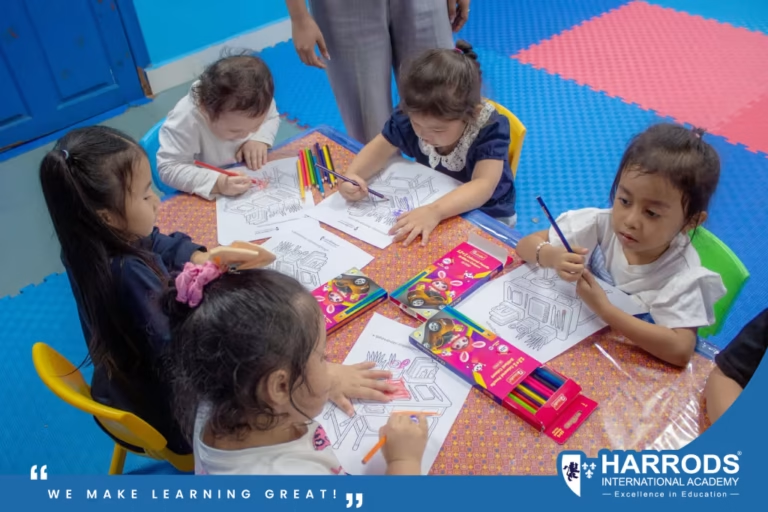
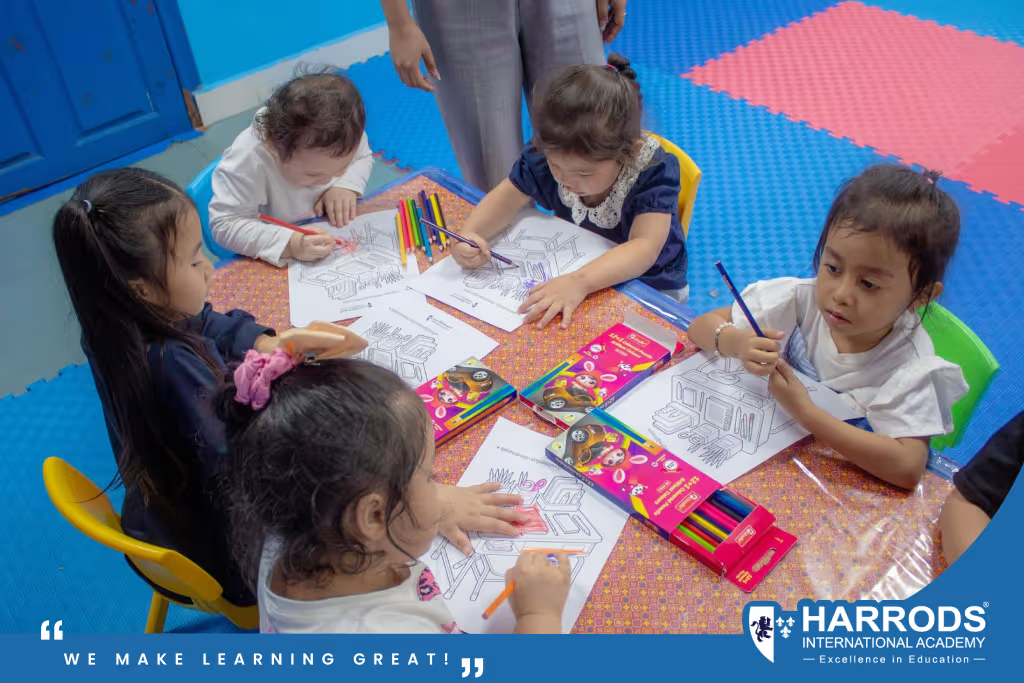
IEYC emphasises child-centred, play-based learning. Exploration, discovery and hands-on experiences provide children with opportunities to follow their curiosity while educators purposefully guide learning.
This matters because play provides young learners with an accessible way to investigate their surroundings. Children can experiment, communicate and solve simple problems while remaining actively involved.
For instance, water play can introduce ideas involving volume, movement and comparison while simultaneously developing language and social interaction.
IPC
IPC moves towards theme- and project-based learning, with greater emphasis on academic knowledge, research, collaboration and practical application.
This progression is appropriate because primary-age learners can increasingly investigate topics systematically and communicate more complex conclusions.
Students exploring environmental sustainability, for example, could research waste at school, collect information and develop recommendations. Both IEYC and IPC encourage active participation, but the complexity and structure increase as children mature.
3. Main Learning Objectives
IEYC
IEYC focuses on building foundations. It supports social and emotional development while encouraging curiosity, confidence, communication and emerging physical and cognitive abilities.
These foundations matter because children’s attitudes towards learning begin developing early. Confidence to explore, communicate and attempt unfamiliar activities can influence how students respond to increasingly challenging learning later.
Storytelling activities, for example, can develop vocabulary and listening while encouraging imagination, social interaction and confidence in sharing ideas.
IPC
IPC builds subject knowledge and transferable skills while encouraging greater independence, international-mindedness, critical thinking and collaboration.
These objectives correspond with primary students’ increasing capacity to take responsibility for aspects of their learning.
A group research project might require students to find information, decide how to organise it and present conclusions. They therefore develop academic understanding alongside teamwork and independent thinking.
4. Curriculum Structure
IEYC learning experiences are structured around developmental needs and meaningful themes. Activities can connect several areas of development rather than treating each experience as belonging exclusively to a formal academic subject.
IPC also uses thematic learning, but students progressively encounter greater subject depth and more clearly defined knowledge and skills.
This creates a natural progression. A young child might explore plants through stories, sensory activities and outdoor observation. During primary education, a related theme could involve scientific investigation, written research and analysis of how plants interact with different environments.
5. Role of Play and Exploration
IEYC
Play occupies an important role in IEYC. Sensory activities, storytelling, creative play and exploration allow young children to learn through direct experiences.
This is important because play can simultaneously support cognitive, emotional and social development. A role-playing activity, for example, can require children to communicate, negotiate roles and use imagination while learning about everyday situations.
Play should therefore not be interpreted as separate from learning. Within an effective Early Years environment, carefully designed play experiences can have clear developmental purposes.
IPC
As students progress into IPC, practical experiences remain important, but activities become increasingly structured around projects, investigations, group tasks and research.
Primary students might conduct a simple experiment, investigate a historical question or develop a collaborative presentation. These experiences retain the active nature of Early Years learning while introducing greater academic responsibility.
6. Development of Key Skills
Both frameworks develop skills, but the expected level changes with age. IEYC can strengthen early communication, confidence, physical coordination, social interaction, creativity and emerging independence.
These abilities establish the foundations upon which more sophisticated academic skills can develop. A child learning to explain what they created during a play activity, for instance, is practising communication and reflection at an age-appropriate level.
IPC builds upon these foundations through research, critical thinking, collaboration, communication and increasingly independent learning. A primary student may be expected not only to explain an idea but also to find supporting information, compare perspectives and communicate a reasoned conclusion.
7. International-Mindedness and Global Awareness
IEYC can introduce children to different people, cultures, communities and environments through age-appropriate experiences. Stories, celebrations, music and classroom discussions can help young learners recognise that people may have different experiences and traditions.
Early cultural understanding is important because attitudes towards difference and belonging begin developing from a young age.
IPC develops this perspective further by encouraging learners to examine global topics and compare viewpoints. Students might investigate how communities in different countries address environmental, social or economic challenges. International-mindedness therefore progresses from early awareness towards increasingly informed understanding.
8. Assessment and Tracking Student Development
IEYC
Assessment during the Early Years can rely substantially on observation of children’s participation, progress and development rather than formal testing alone.
This approach is appropriate because young children demonstrate learning in many ways. Teachers can observe how a child communicates, interacts, solves problems and approaches unfamiliar activities.
For example, an educator might record how a child progresses from requiring significant assistance during an activity to completing similar tasks with greater independence.
IPC
Assessment becomes more structured during primary education as teachers monitor subject knowledge, skills and learning outcomes.
Projects, classroom activities and ongoing assessment can provide evidence of student understanding. Teachers may evaluate not only whether a learner knows information but also whether they can research, communicate and apply it.
The transition demonstrates how assessment can evolve alongside children’s development rather than remaining identical throughout schooling.
9. How IEYC and IPC Support Holistic Development
Both curricula extend beyond academic achievement. They can contribute to social and emotional development, communication, creativity, physical abilities, confidence, collaboration and independence.
The difference lies largely in emphasis. IEYC concentrates on establishing developmental foundations through age-appropriate experiences, while IPC builds on those foundations through more structured academic and skills-based learning.
For example, collaboration in Early Years might involve sharing materials and completing a play activity together. In primary education, collaboration could require students to divide responsibilities within a research project and collectively present their findings. The underlying ability develops continuously, but expectations become more sophisticated.
IEYC vs IPC: Which Curriculum Is Right for Your Child?
1. For Children in the Early Years
IEYC may be appropriate for children who are at the early childhood stage because its approach recognises play, curiosity and developmental learning as central components of education.
This environment can help children establish foundational communication, social, physical and cognitive abilities before the expectations of formal primary education increase.
Parents considering Early Years education should therefore examine whether a school provides sufficient opportunities for purposeful play, exploration, interaction and individual development rather than concentrating only on early academic results.
2. For Primary-Age Children
IPC is specifically designed for primary education, when learners are ready to develop greater academic knowledge and increasingly sophisticated skills.
Its thematic and project-based approach can encourage students to research, collaborate, communicate and connect subjects with real-world contexts.
For children progressing from Early Years, IPC can build upon existing curiosity and confidence while introducing greater structure, responsibility and academic depth.
IEYC vs IPC: Comparison at a Glance
Factor | IEYC | IPC |
Target Stage | Early Years | Primary |
Learning Style | Child-centred and play-based | Theme- and project-based |
Main Focus | Early childhood development | Knowledge and skills |
Assessment | Developmental and observational | Learning outcomes and skills |
Global Awareness | Introduced at an early stage | Developed more extensively |
Independence | Builds confidence and foundational independence | Encourages increasingly independent learning |
Key Outcome | Strong foundations for future learning | Preparation for continued academic development |
Why Parents Should Understand the Difference Between IEYC and IPC
Understanding IEYC vs IPC can help parents select an age-appropriate educational environment rather than judging curricula solely by how academically advanced they appear.
This distinction is important because introducing greater academic structure earlier does not automatically make a curriculum better. Young children and primary-age learners have different developmental needs, and educational expectations should correspond with those stages.
Understanding the progression can also help parents evaluate continuity when searching for the best school in Phnom Penh for their child. Families can ask how an institution transitions students from Early Years into primary education, how teaching methods evolve and how teachers support children who progress at different rates.
Parents should therefore examine curriculum structure, assessment, teaching approaches and student support. The most appropriate curriculum is the one aligned with the child’s developmental stage and educational needs rather than whichever framework appears more academically demanding.
Conclusion
The central difference between IEYC and IPC is their intended stage of education. IEYC is an early years curriculum centred on play, exploration, developmental learning and foundational abilities. IPC is an international primary curriculum that builds upon these foundations through thematic learning, projects, subject knowledge and increasingly sophisticated transferable skills.
Despite these differences, both frameworks share important principles. They encourage children to participate actively in learning, develop beyond academic knowledge and gradually understand the wider world.
For parents, comparing IEYC vs IPC should therefore not be about deciding which curriculum is universally superior. Instead, the priority should be finding an educational approach appropriate for the child’s age, developmental readiness and individual learning needs.
By examining curriculum structure, teaching philosophy, assessment methods and progression between educational stages, families can make more informed choices about an international school and provide children with an environment designed to support both present development and future learning.
Frequently Asked Questions
The International Early Years Curriculum supports development through child-centred, play-based and exploratory learning experiences. It recognises that young children develop academically, physically, socially and emotionally at the same time. Purposeful activities can therefore strengthen communication, creativity, confidence and emerging literacy and numeracy alongside broader developmental abilities.
IEYC can support areas including communication, personal and social development, physical development, creativity, early literacy and numeracy, and children’s understanding of the world. These areas are interconnected so that one activity can contribute to several aspects of development rather than focusing exclusively on a single academic skill.
IEYC promotes holistic development by recognising that early education involves more than academic preparation. Play, exploration, communication and interaction can support cognitive abilities while simultaneously developing physical coordination, social relationships, emotional awareness, creativity and confidence.
Students following IPC can develop subject knowledge alongside research, communication, collaboration, critical thinking and independent learning. Its thematic approach can also encourage students to make connections between subjects and consider topics from international perspectives, helping them apply knowledge beyond individual classroom exercises.
IPC can promote holistic learning by integrating academic knowledge with personal and international development. Thematic units allow learners to investigate questions across subjects while projects and collaborative activities strengthen skills such as communication, creativity, teamwork, research and problem-solving.