Every parent wants to give their child the best start in life, especially when it comes to education. The early years of childhood are considered the most crucial stage of development because this is when children build the foundation for learning, behaviour and emotional growth.
During this period, the right learning environment can shape not only academic readiness but also character, curiosity and self-confidence. One early childhood programme that has gained global recognition for its high-quality framework is the Cambridge Early Years Curriculum, designed by Cambridge Assessment International Education. Unlike traditional preschool programmes that focus mainly on readiness for reading and writing, this curriculum offers a holistic approach, helping children develop academically, socially, emotionally and physically in a well-balanced learning environment.
This post will guide parents on what the Cambridge Early Years Curriculum is, why it stands out, and how it benefits young learners as they progress in their education journey.
What is the Cambridge Early Years Curriculum (IEYC)?
The Cambridge Early Years Curriculum, sometimes referred to as the International Early Years Curriculum (IEYC) in schools following a Cambridge pathway, is a structured programme for children between the ages of 3 to 6. It serves as the foundation stage of the Cambridge curriculum, which later progresses into primary, lower secondary and eventually the Cambridge IGCSE curriculum levels for older students. This early years curriculum lays the groundwork for lifelong learning by introducing key developmental areas through play-based and inquiry-led education.
This curriculum is designed to align with how young children naturally learn. Instead of relying solely on academic instruction, it encourages children to explore, ask questions and discover knowledge through hands-on experiences. This early years curriculum nurtures language skills, numeracy, social development, creativity and physical coordination in an integrated manner. It acknowledges that children in this age group learn best when activities are meaningful, imaginative and connected to real life.
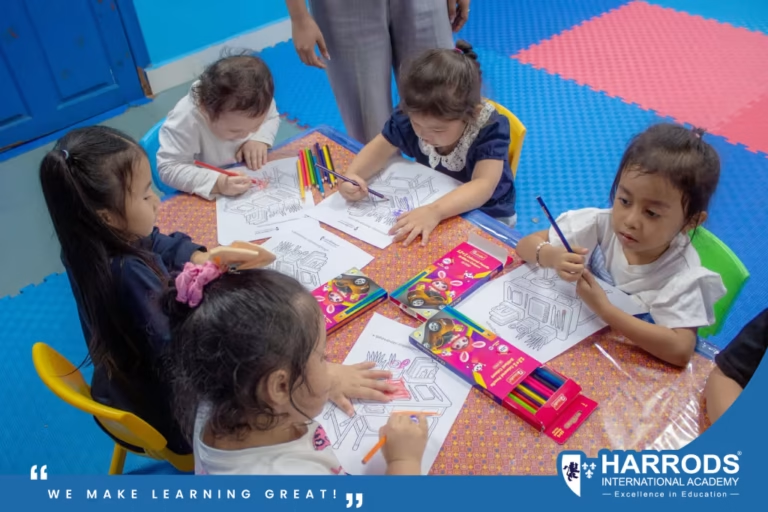
For example, instead of only teaching numbers through worksheets, a teacher might use counting games with blocks, nature walks to observe shapes or role-play activities involving shops where children handle pretend money. These methods help children make sense of the world around them and connect learning with daily life, which in turn makes learning enjoyable and purposeful.
What are features of the Cambridge IEYC?
The Cambridge Early Years Curriculum is built around a few key features that make it effective and engaging. First, it uses a play-based learning approach, which means lessons are delivered through structured play that encourages cognitive and emotional development. This is important because play is how children naturally make sense of their environment. By integrating learning into play, the curriculum develops early literacy, numeracy and language skills while also building curiosity and imagination.
Another important feature is child-centred learning, which gives children the freedom to explore topics based on their interests. Teachers act as facilitators, guiding learning through conversation, exploration and problem-solving activities rather than strict instruction. This approach encourages confidence and independence, helping children become active rather than passive learners.
Additionally, the Cambridge Early Years Curriculum focuses on holistic development, addressing emotional well-being, communication skills, motor development and creativity along with academic readiness. This prepares children for future stages of education and ensures they feel valued, motivated and supported during their early learning years.
An example of this can be seen in how a topic like “Animals Around the World” might be taught. Children might listen to stories about animals, draw pictures, sort animals based on habitat, act out animal movements and even learn new vocabulary related to animal names. This interconnected method supports multiple learning areas at once.

Serves as a Strong Academic Foundation for the Child
The Cambridge Early Years Curriculum provides a strong academic foundation by introducing children to literacy and numeracy in an age-appropriate manner. At this stage, children begin recognising letters, sounds and words, and are introduced to early reading strategies. In numeracy, they develop number sense, counting ability, shape recognition and basic measurement skills.
This academic preparation is important because it forms the building blocks for future learning. Children who receive a solid start in literacy and numeracy are more confident when transitioning into primary school and can follow lessons more independently. Early exposure to structured learning routines also prepares children for future academic milestones in the Cambridge curriculum and beyond.
For example, children practise phonics to support reading fluency. They also engage in simple STEM-based activities such as building towers with blocks or exploring water flow, which introduces them to scientific thinking. These early skills lay the groundwork for subjects like mathematics and science later in school.
Nurtures Critical Thinking and Problem-Solving Skills
The Cambridge Early Years Curriculum actively promotes critical thinking by encouraging children to investigate, question and solve simple problems. Through inquiry-based learning, children are taught not just what to think but how to think. They are encouraged to explore ideas, compare outcomes and explain their reasoning.
This skill is important because it prepares children for real-world decision-making and helps them face future academic challenges with confidence. Developing problem-solving abilities at a young age promotes independence and resilience.
For instance, during a classroom activity involving building a bridge with craft materials, children might be encouraged to think about how to make it strong enough to hold a toy car. They will try different materials and methods, learning through trial and error. This simple exercise builds reasoning, planning and creativity.
Encourages the Child to be an Independent Learner
Independence is one of the core values of the Cambridge Early Years Curriculum. Children are given responsibilities such as organising their learning space, choosing their activities and taking care of classroom materials. These routines help them become self-motivated and responsible learners.
This is important because independent learning fosters confidence and ownership of personal progress. Children who develop independence early tend to perform better academically as they grow older, as they are more likely to take initiative and manage tasks without constant guidance.
For example, a teacher may set up learning stations in the classroom and allow children to choose which station to visit. This encourages decision-making and time management, while still being supported in a structured environment.
Creating a Path for Better Future Opportunities
The Cambridge Early Years Curriculum is globally recognised and seamlessly connects to the Cambridge Primary and Cambridge Lower Secondary curriculum before progressing to IGCSE. This continuity gives students a smooth educational journey and opens doors to international qualifications that are highly regarded by universities and employers around the world.
This is important because early exposure to a structured international curriculum increases academic confidence and sets long-term learning goals. Children who begin with the Cambridge Early Years curriculum find it easier to adjust to future expectations of the Cambridge curriculum IGCSE programme.
For example, children who begin early in a Cambridge pathway often excel in communication, research and collaborative learning—skills that contribute to strong performance in later academic stages, including the IGCSE examinations.
Provides Ways for the Child to Cultivate Social and Communication Skills
The Cambridge Early Years Curriculum emphasises social interaction, teamwork and emotional development. Through group activities, storytelling sessions and classroom discussions, children learn to express their thoughts, listen to others and work together respectfully.
This is important because social and communication skills are essential for overall development and success in life. Children who can express themselves clearly and collaborate effectively are more likely to become confident students and empathetic individuals.
For example, children may participate in role-play activities where they pretend to run a shop, take turns as customers and shopkeepers, and communicate using polite language. These interactions build emotional intelligence and verbal skills.